Dameo
Dameo draughts uses all 64 squares and has diagonal and orthogonal movement
The board
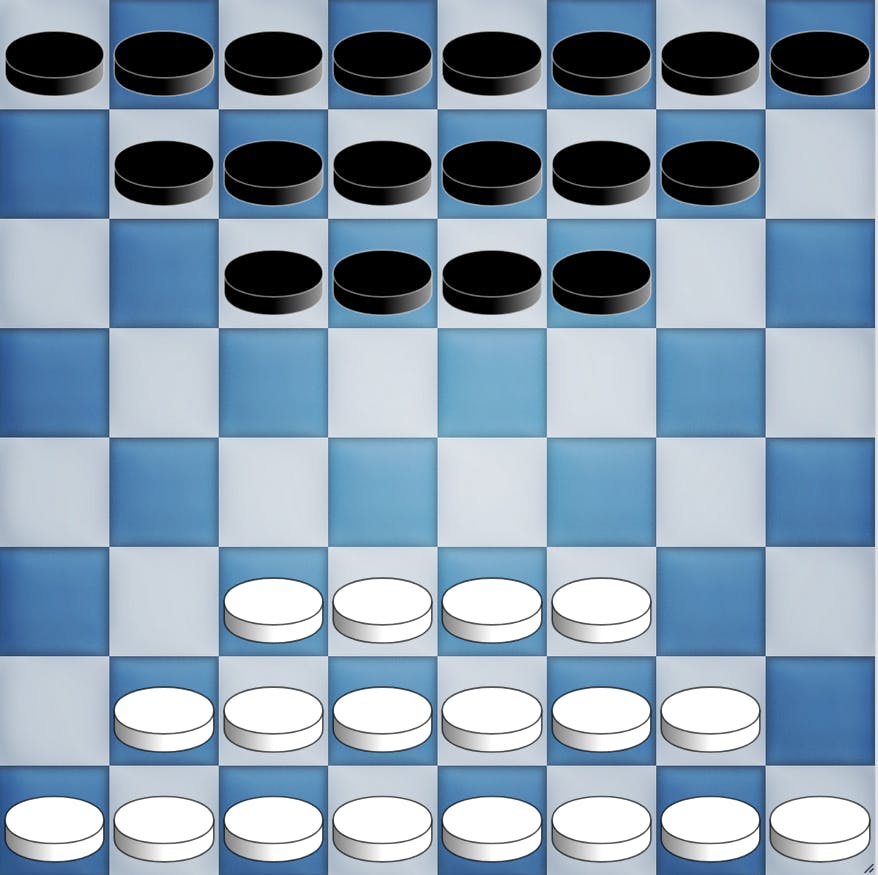
Dameo is a Draughts variant invented by Christian Freeling in 2000 which is played on a 8x8 board. Unlike the other Draughts variants on PlayStrategy, all of the squares on the board are available for use in Dameo.
Both players (white and black) start with 18 pieces or men, placed on opposite sides of the board as shown.
Moving and Capturing
White begins the game.
- A man can only move forward, either straight ahead or diagonally.
- In addition, men can jump over one or more adjacent men of the same color in a straight line, forward or diagonally, as long as the square at the front of the line is free.
- When a man reaches the last row on the opposite side of the board, it is crowned, or promoted, to a king. The king can move in all eight directions to any open cell within line of sight (i.e. not being blocked by a man or king), like a queen in chess.
- Capturing involves jumping over enemy pieces and removing them from the board. All captures in Dameo are orthogonal only. A man may capture an adjacent enemy piece, forwards, backwards, or sideways, by a jump to an empty square directly beyond the captured piece. Capturing is mandatory, even if doing so incurs a disadvantage.
- A king may capture an enemy piece by long jumping from any distance away to any empty square opposite the captured piece, so long as there is no other piece obstructing the path of the king.
- Multiple successive captures in a single turn must be made if, after each jump, there is an unoccupied square immediately beyond another enemy piece. The active player must play with the piece that can make the maximum number of captures.
- A jumped piece is removed from the board at the end of the turn. For a multi-jump move, captured pieces are not removed during the move; they are removed only after the entire multi-jump move is complete.
- The same piece may not be jumped more than once.
Winning and drawing
- A player with no valid move remaining loses. This occurs if the player has no pieces left, or if all the player's pieces are obstructed from moving by opponent pieces.
- A game is considered a draw when the same position repeats three times by the same player (not necessarily consecutively).
- A game is automatically ruled as a draw when both sides have exactly 1 king each, and 4 moves have been played in this material state.
- The game is drawn when both players make 25 consecutive king moves without capturing.