Entropy
Start a gameBuild symmetric colour patterns as Order, and break them up as Chaos
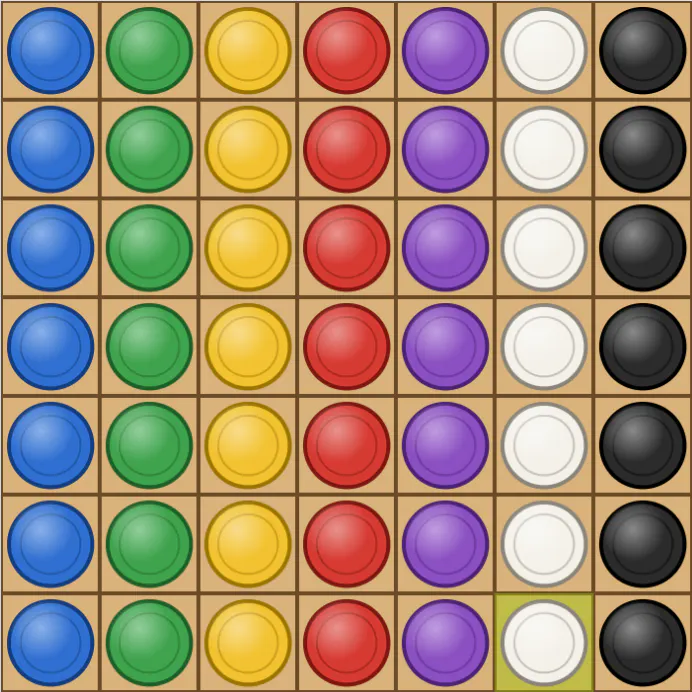
Entropy was designed by Eric Solomon in 1977. The game is "based on the eternal conflict in the universe between order and chaos". One player is Order, the other Chaos. Order is trying to make patterns vertically and horizontally. Chaos is trying to prevent this.
Rules
Entropy is played on a 7×7 board. A match is two games. The players swap roles between them, so each player players one game as Order and one game as Chaos. Only Order scores, and whoever scores more as Order wins the match.
The Counters
There are 49 counters: seven each of seven colours (white, black, yellow, green, red, blue and purple). The counters start in a bag and are drawn at random, so neither player knows which colour comes next.
The bag always holds whatever isn't on the board yet, so you can work out which colours are still to come.
How a turn works
Chaos and Order take turns, and Chaos always starts.
- Chaos draws a counter from the bag and places it on any empty square.
- Order then either slides one counter or passes.
This repeats until the board is full. The 49th counter placed by Chaos ends the game, so Order doesn't get a move after it.
Playing as Chaos
- Each turn, draw a counter from the bag and place it on any empty square.
- You don't choose the colour. You only choose where it goes.
- Your aim is to stop patterns forming. Put counters where they break up symmetry, for example next to different colours, or where they spoil a pattern Order is building.
- Chaos never scores. You win by holding your opponent's score as Order below your own score as Order.
Playing as Order
- Each turn, you may slide any counter on the board, including the one Chaos just placed.
- Counters slide like a rook in chess: any number of empty squares in a straight line along a row or column. A counter can't jump over another counter, and it must land on an empty square.
- You may also pass instead of moving.
- Your aim is to build patterns. Move counters to make runs of colours along rows and columns that are symmetrical.
- Your score is shown during the game. It only counts patterns that are already certain to survive, so the number never goes down, unless you break your own patterns.
Scoring
Order scores for every symmetrical pattern on the board at the end of the game. A pattern is a run of two or more touching counters in a row or column that reads the same in both directions, like a palindrome. Diagonals don't count.
- Each pattern scores its length: a pattern of 2 counters scores 2, a pattern of 5 scores 5, and so on.
- Patterns inside other patterns count separately. Overlapping patterns each score too.
Every row and every column is scored in this way, and the scores are added together to give Order's total for that game.
Scoring Examples
In the following examples we refer to each counter with a letter, with distinct letters representing distinct colours.

In the ABBA example above, it scores 6. The whole run scores 4, plus 2 for the middle two counters which are the same (ABBA).

In the ABCBA example above, it scores 8. The whole run scores 5, plus 3 for the BCB in the middle.

In the AAA example above, it scores 7. The whole run scores 3, plus there are two runs of two counters, scoring 2 each (AAA and AAA).

In the ABBBAB example above, it scores 15 which is made up of:
- ABBBAB scores 5
- ABBBAB scores 7
- ABBBAB scores 3
Winning
When both games have finished, compare the two Order scores. The higher score wins the match, and equal scores are a draw.
Clocks
Both player's clocks go back to their starting time when the roles swap for the second game.
Running out of time doesn't lose the game in a live game. For the rest of that game, your moves are made for you:
- As Order, you always pass.
- As Chaos, your counter is placed on the first empty square, counting from a1 to g7.
In Correspondence games, running out of time loses the match.
A player may resign at any time, and resigning ends the whole match straight away.
Play Entropy online for free: live or by correspondence, rated or casual, against players from all over the world. Build symmetric colour patterns as Order, and break them up as Chaos. All about Entropy on PlayStrategy »