Renju
Start a gameMake exactly five in a row; black must avoid the forbidden double three, double four and overline
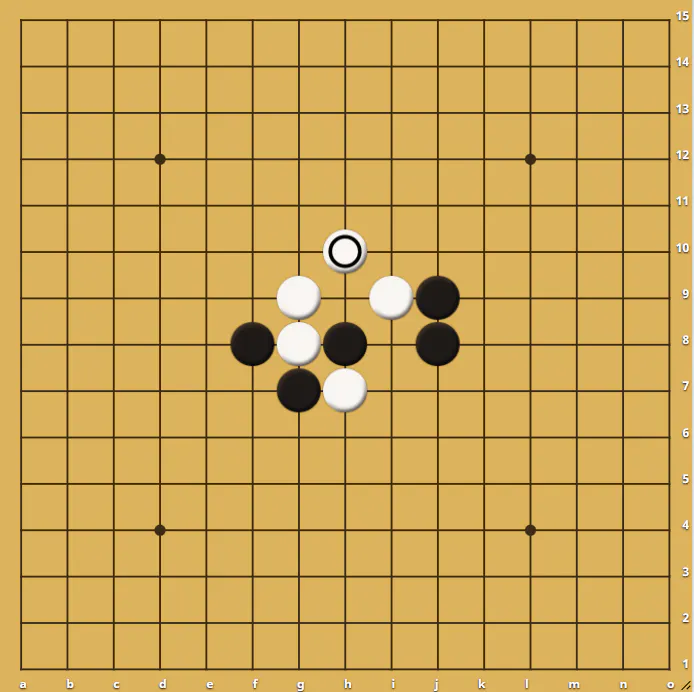
Renju is the professional version of five in a row. It is played on a 15×15 board like gomoku, but black, who has the first-move advantage, is not allowed to play certain moves. If black plays one of these forbidden moves, black loses. Renju opens with the Taraguchi-10 rule.
How to win
- Black wins by making a line of exactly five stones in a row, a column or a diagonal.
- White wins by making a line of five or more, so for white an overline also wins.
- White also wins if black plays a forbidden move.
Rules
- The game is played on the points of a 15×15 board.
- There are two colours, black and white, and black places the first stone.
- Players take turns placing one stone of their colour. Stones are never moved or removed.
- Your colour can change during the opening.
- White has no restrictions. Black has forbidden moves.
Forbidden moves (black only)
Black may not play a stone that creates any of these:
Double three
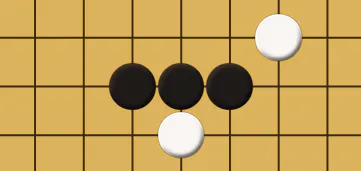
A "double three" is placing a stone to create two "threes" at once. A three is a line that one more stone would turn into an open four, meaning four in a row with both ends free. An example of a "three" is:
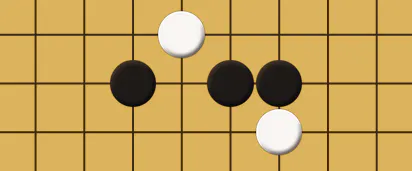
Broken threes count as well. An example of a broken three is:
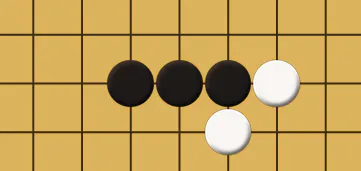
A three that white has already blocked does not count. An example of a blocked three is:
Therefore an example of a double three is:
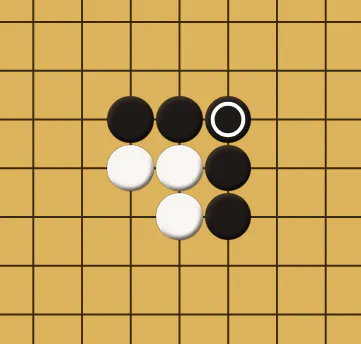
A second example of a double three is:
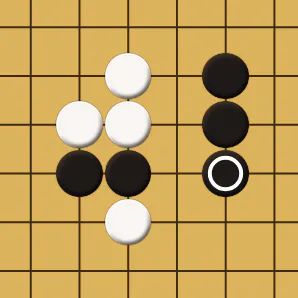
Double four
A "double four" is placing a stone to create two "fours" at once. A four is a line that one more stone would turn into exactly five. An example of a four is:
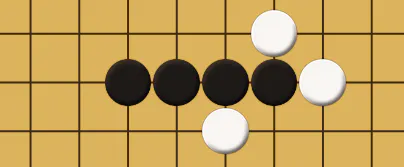
Therefore an example of a double four is:
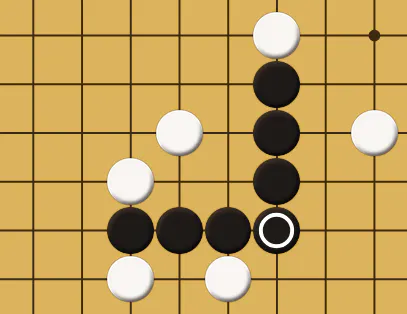
Overline
An "overline" is placing a stone to create six or more black stones in a row. An example of an overline is:
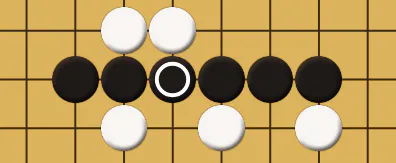
Things to know about forbidden moves:
- A move that makes exactly five is never forbidden, even if it creates one of the shapes above at the same time.
- One three plus one four together is allowed.
- A forbidden move can still be played, but black loses at once and white wins.
- PlayStrategy warns black when there is a forbidden point(s) on the board, with a message but not where they are.
Opening (Taraguchi-10)
- The first stone (black) goes on the centre point.
- The second stone (white) goes within the 3×3 square around the centre.
- The third stone (black) goes within the 5×5 square.
- The fourth stone (white) goes within the 7×7 square.
After each of these four stones, the player due to move next can swap colours instead of playing. This is offered once per stone.
- For the fifth stone, black chooses between two options:
- Place it within the 9×9 square. The player with white may then swap once more, and white places the sixth stone anywhere.
- Offer 10: black places ten candidate fifth stones anywhere on the board. No two of them may be symmetrical copies of each other, meaning a rotation or reflection of the position would turn one into the other. White picks one to keep, the other nine are removed, and white then places the sixth stone anywhere.
Normal play follows, one stone per turn.
Game end
- The game ends as soon as a player makes a winning line, or black plays a forbidden move.
- If the board fills up with no winner, the game is a draw.
Play Renju (professional Gomoku) online for free: live or by correspondence, rated or casual, against players from all over the world. Make exactly five in a row; black must avoid the forbidden double three, double four and overline. All about Renju on PlayStrategy »